Searching for Layers - Issue#17
But it is a one-layer world


There is a specific kind of internal vertigo that hits when you realize you have spent three weeks analyzing the “subtext” of a text message that was actually written by someone who does not even know the difference between “your” and “you’re”. We like to imagine that every human being is a vast, shimmering ocean of complexity, a cinematic landscape of repressed trauma, Victorian-era pining, and intricate philosophical frameworks. We treat people like high-concept Christopher Nolan movies, convinced that if we just squint hard enough, the timeline will make sense.
Then, one Tuesday afternoon, you’re sitting across from someone you’ve deified as a “tortured soul”, and you realize the vacant look in their eyes isn’t existential dread. They’re just trying to remember if they left the stove on.
It is a humbling, slightly rude awakening to find out that while you were busy writing a five-act play about their “enigmatic silence”, they were actually just mentally ranking their favorite flavors of Gatorade. We are all out here playing 4D chess with people who are barely managing a game of Connect Four.
The Architectural Flaw of Over-Thinking
The problem with being an over-analyzer is that you end up building an elaborate cathedral over a sandbox. You assume everyone has a “basement”, that dark, damp place where they keep their true motives and their childhood scars. You spend your energy trying to pick the lock to that basement, only to find out the house is built on a slab. There is no downstairs. There is just a living room with a slightly stained rug and a TV that has been left on a 24-hour loop of The Office.
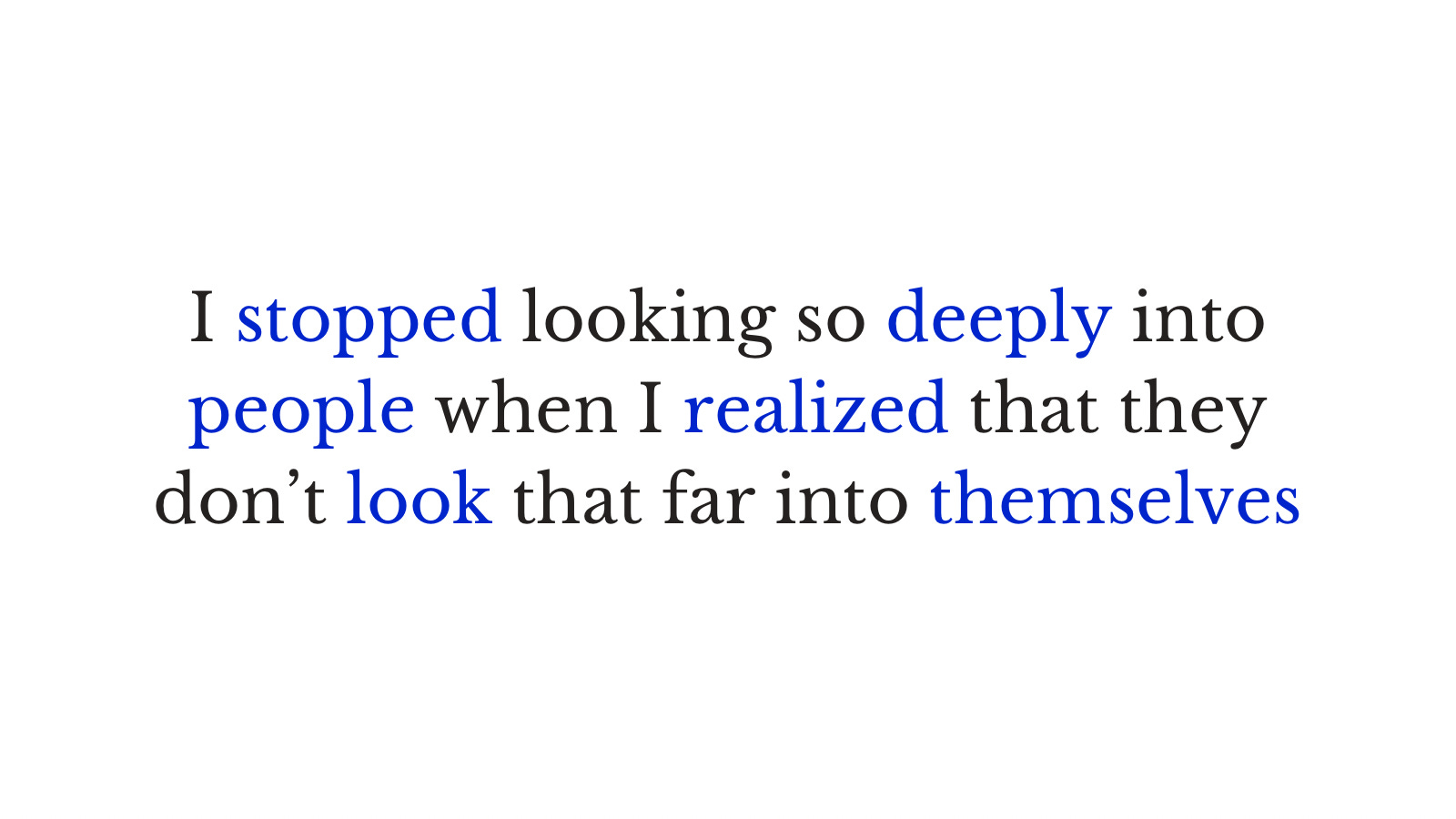
When you look deeper into someone than they look into themselves, you are not seeing them. You are seeing your own reflection in their sunglasses. You are projecting your own depth onto a surface that was never meant to hold that much weight. It is like trying to download a 4K movie onto a calculator. Eventually, the hardware gets hot and starts smelling like burnt plastic.
Realizing that most people are operating on “factory settings” is not a cynical take; it is actually a massive relief. It means the weird thing they said at dinner was not a calculated jab at your insecurities. It was just a random sequence of words that escaped their mouth before their brain could form a perimeter.
The Freedom of the Surface Level
Once you stop treating everyone like a puzzle box to be solved, the world gets a lot quieter. You stop being a psychological detective and start being a person who can just enjoy a sandwich. There is a profound, almost spiritual peace in accepting that someone’s “vibe” is not a riddle. If they seem distant, maybe they are not “grappling with the duality of man.” Maybe they just stayed up too late watching videos of people power-washing driveways.
This isn’t to say people are shallow in a bad way. It’s just that self-awareness is exhausting. Looking inward requires a flashlight, a map, and a willingness to admit you are kind of a mess. Most people are just trying to get through the day without losing their car keys or having an awkward encounter in an elevator. They are not staring into the abyss; they are staring at the “Skip Ad” button on YouTube.
When we stop digging for gold in every conversation, we finally have the energy to look at what is actually in front of us. Relationships become less about “cracking the code” and more about just showing up. The depth we were looking for was never meant to be found in others anyway. It is our own internal mess that needs attention. So let people be the two-dimensional characters they often prefer to be. It saves a lot on the mental electricity bill, and frankly, the view from the surface is usually much better.
Wishing everyone a lovely rest of the week.
Until next time!
Love,
Chris🫶🏼
“We are all out here playing 4D chess with people who are barely managing a game of Connect Four.” Summed it up gorgeously. Thanks for sharing.
Totally understand this way of thinking!