Enough Isn’t Enough for Some - Issue#27
Surrounded by plenty, yet distracted by your piece.

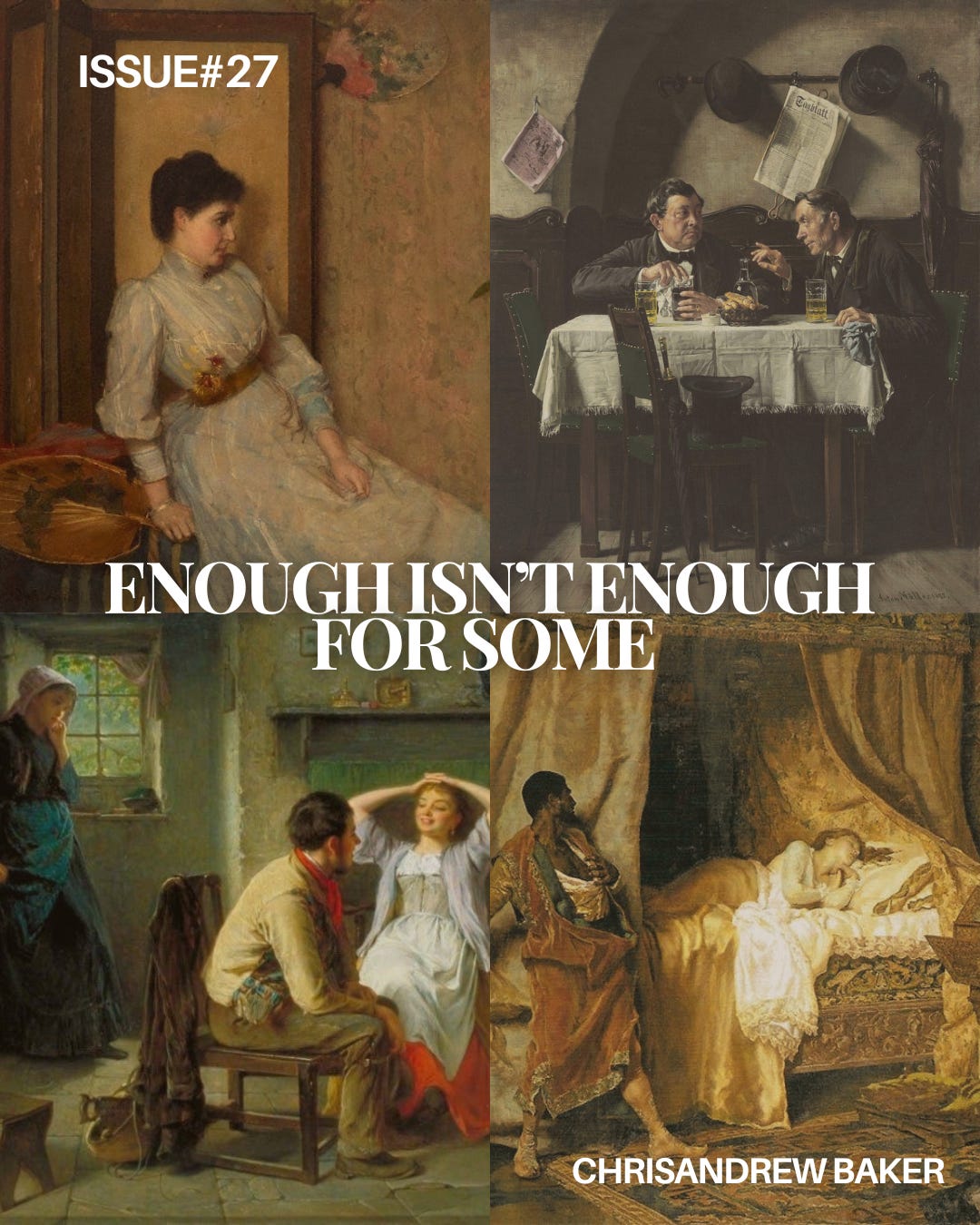
There is a strange phenomenon in human behavior that no school can fully prepare you for. It is not found neatly between theories of motivation or behavioral psychology. It shows up in kitchens, group chats, offices, family gatherings, and comment sections. Some people will have a whole loaf and still be jealous of your slice.
Not your bakery, not your oven, not your ingredients, just your slice. The one that is already half eaten, lightly buttered, and honestly not that special. And yet, somehow, it becomes a problem for them.
It would be funny if it were not so consistent.
Full Fridges and Empty Satisfaction
Picture someone opening their fridge and seeing it packed. Drinks, snacks, leftovers, desserts, everything they could reasonably want. By any logical measure, they are fine. Well fed even. Yet somehow they still find time to be emotionally invested in what is on your plate.
You could be holding a simple slice of bread and suddenly it becomes a statement. Why does yours look satisfying? Why does yours seem enough? Why does theirs feel like it is missing something?
This is not about hunger. It is about perception. And perception has a way of making people feel deprived even when they are surrounded by abundance.
The Illogical Nature of Jealousy
Jealousy is often assumed to come from lack, but that explanation is too simple. People do not only envy what they do not have. They also resent what others manage to be at peace with.
Jealousy is not always vertical, looking up at something better. It is often lateral, staring sideways at something simpler. A person can have more but still feel disturbed by someone who has less but appears content.
That is what makes it irrational. It is not about quantity. It is about comparison and interpretation.
When Enough Becomes Uncomfortable
There is something about contentment that unsettles people. A slice of bread is small, ordinary, and unremarkable. That is exactly why it becomes symbolic. It represents a kind of ease that some people struggle to understand.
When someone sees you satisfied with your slice, it can trigger uncomfortable questions. Why is this enough for them? Why is it not enough for me? What am I missing that they are not chasing?
Instead of sitting with those questions, it is easier to reduce your slice in their mind. Make it smaller, less meaningful, less valid. Not because it changed, but because it is easier than self reflection.
The Comedy of Comparison
Modern life has turned comparison into a constant habit. People compare careers, relationships, appearances, timelines, and even moments of happiness. A person can have stability and still feel insecure because someone else posted a better version of joy online.
It becomes almost absurd. Someone with a full life can feel challenged by someone else simply enjoying theirs in peace. It is like owning an entire bakery and feeling offended because someone else’s toast looked slightly more satisfying in the moment.
The real issue is that comparison does not improve the person comparing. It only steals attention from their own life.
At the end of it all, the slice was never the problem. It was simply the closest thing to project onto. Some people are not reacting to what you have, they are reacting to what your peace exposes in them.
So you eat your slice. Not because it is more, but because it is enough.
Wishing everyone a lovely rest of the week.
Until next time!!
Love,
Chris🫶🏼
Chris, this was beautifully put, especially the idea that people are reacting to others’ peace.
I wonder if it’s less about comparison, and more about what someone else’s slice quietly exposes.
Sometimes what unsettles us is that, for someone else, it’s already enough…